Last updated:
Rome’s public transport is excellent value and gets you close to most attractions — but the historic centre is best explored on foot. The walk from Piazza Navona to the Pantheon to the Trevi Fountain is one of Rome’s great pleasures, and no bus or metro will take you between them. The Metrebus network integrates metro, buses, trams and urban trains under a single ticketing system — one ticket covers everything within the city. This guide covers all ticket types, fares, lines and practical tips including contactless payment, so you know exactly when to ride and when to walk.
Rome Transport Zones
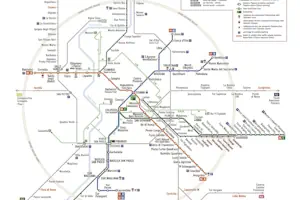
Rome’s metro, buses, trams and urban trains are part of the Metrebus fare system. The entire city falls within two zones (Zone AB). Zone boundaries are marked in red on the map. The rest of the Lazio region is divided into further zones. All major sights in Rome are within Zone AB.
Fares and Tickets
| Metrebus Tickets | Price | Validity | Metro Access |
|---|---|---|---|
| BIT (single ticket) | €1.50 | 100 minutes | 1× |
| 24h | €8.50 | 24 hours | unlimited |
| 48h | €15.00 | 48 hours | unlimited |
| 72h | €22.00 | 72 hours | unlimited |
| CIS (weekly pass) | €29.00 | 7 days | unlimited |
A single ticket (BIT) is valid for 100 minutes on all transport within the city, with one entry to the metro. The 24h, 48h and 72h passes are worthwhile from around 5 journeys per day. The weekly CIS pass becomes economical from just 3 journeys a day.
Which ticket should you buy? For most visitors staying in the city centre, Tap & Go contactless payment is the simplest option — you automatically pay the best fare and never more than the daily cap of €8.50. If you know you’ll be making frequent trips, a 48h or 72h pass offers better value. For stays of five days or more, the weekly CIS pass is the most economical choice. Several Rome tourist passes include a 48h or 72h transport ticket as part of the package.
Children under 10 travel free. A ticket is required for luggage exceeding 50×30×25 cm, bicycles and pets – guide dogs excepted.
Where to buy Metrebus tickets
Tickets are available at machines in metro stations and at some larger bus stops — but be aware: if you don’t already have a rechargeable ATAC chip card, the machine will automatically issue you one with your first purchase. The card is free if you spend at least €4.50 (3 or more tickets), but costs €0.50 for smaller purchases. Each traveller needs their own card. For a single ticket, the machines are more hassle than they’re worth — a Tabacchi shop or Tap & Go contactless payment is a much simpler option.
Fares to and from the airport
The standard Metrebus ticket is not valid for Rome Fiumicino airport or for the Leonardo Express. A 3-zone ticket is required for Fiumicino. Further information: Fiumicino Airport · Ciampino Airport
Contactless Payment: Tap & Go
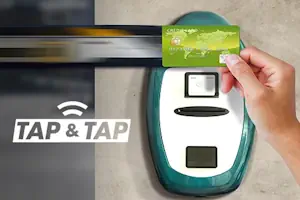
At the turnstiles in metro stations you can pay contactlessly with a credit or debit card or smartphone. The system also works on buses, trams and the Ostia Lido rail line. Tap & Go is not available on Trenitalia regional trains.
The key advantage: Always using the same card or smartphone means you automatically get the best fare. No second journey is charged when transferring within 100 minutes. A daily price cap also applies automatically: you will never be charged more than the price of a 24h pass (€8.50) within any 24-hour period – without needing to buy a day pass at all.
If your ticket is inspected, you must show the card or smartphone used for the contactless payment.
Travelling to Fiumicino Airport? Trenitalia operates a similar contactless system called Tap & Tap on its regional trains and the Leonardo Express. Simply tap your credit or debit card at the reader when boarding and tap again when you exit at your destination. No ticket purchase needed — the fare is calculated automatically. Note that this is a separate system from the Metrebus Tap & Go.
Apps and Journey Planning
For routes and departure times we recommend Moovit and Google Maps — both deliver reliable results. Moovit is particularly accurate as it generates real-time data from passengers travelling on board. Tickets can also be purchased via app, but we recommend contactless payment or paper tickets instead.
Important warning if you use a ticket app: Do not use an in-app ticket while contactless payment is also active on your phone or card. Rome’s validators cannot always distinguish between the two systems — your contactless card may be charged even when you have a valid app ticket. To avoid being double-charged, either use Tap & Go exclusively or deactivate contactless payment when using an app ticket.
Rome Metro (Underground)
Rome’s metro has three lines:
Line A (orange) opened in 1980. It serves the city centre, the Spanish Steps (Spagna) and the Vatican (Ottaviano). As the busiest line it is often crowded at peak times. Terminal stations: Battistini and Anagnina.
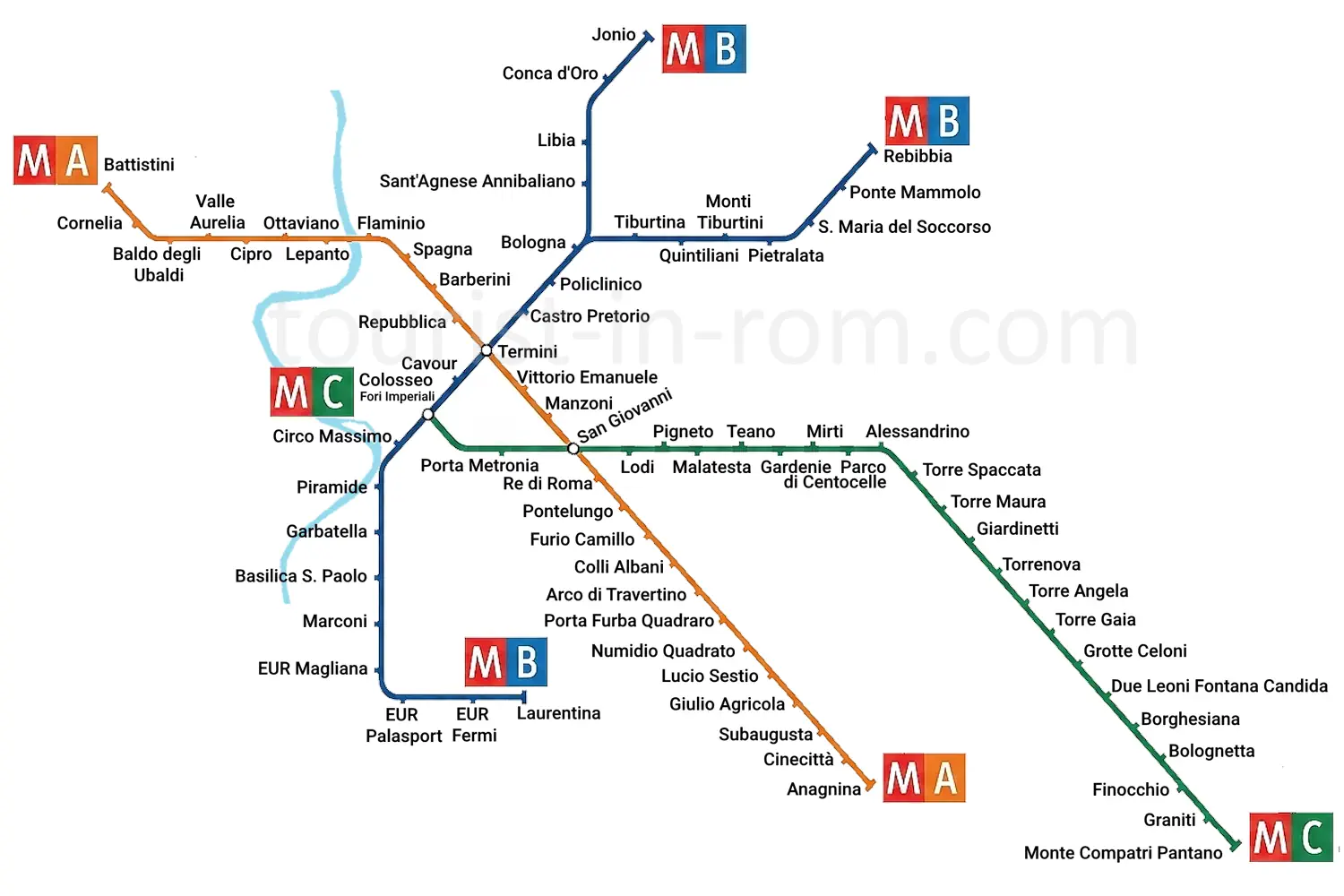
Line B (blue) is the oldest line, dating to 1955. From Laurentina in the south it passes through the Basilica of San Paolo, then the Colosseum (Colosseo) and Roma Termini, continuing northeast to Tiburtina station. At Piazza Bologna the line splits: one branch continues to the terminal at Rebibbia, the other to Jonio.
Line C (green) is Rome’s newest and only driverless line. It runs from Colosseo — where you can transfer to Line B — through San Giovanni (interchange with Line A) and the charming neighbourhood of Pigneto out to Rome’s eastern suburbs. Work is currently underway on a new Piazza Venezia station and a further extension of the line northward — Rome being Rome, timelines remain optimistic.
Lines A and B intersect at Roma Termini.
A tip for culture lovers: The Line C stations at San Giovanni, Porta Metronia and Colosseo are small museums in their own right: significant archaeological finds made during construction are permanently displayed inside the stations – free to see as part of any normal journey.
Operating hours: The metro runs daily from approximately 5:30 to 23:30. On Friday and Saturday nights services run until approximately 1:30.
Bus Lines
Rome’s bus network reaches every corner of the city. Services work well in the centre; in the outer districts they can be infrequent. The most useful lines for tourists:
Bus 23: From St Peter’s Basilica to San Paolo fuori le Mura
Bus 40: Express service from Roma Termini to St Peter’s and Castel Sant’Angelo
Bus 62: Connects Tiburtina station with the Vatican, stopping at Via del Tritone (near the Trevi Fountain and Spanish Steps), Via del Corso, Piazza Venezia, Torre Argentina and Piazza Navona
Bus 64: Crosses the centre from Termini to St Peter’s. Key stops: Piazza Venezia, Torre Argentina, Piazza Navona – but also one of the most popular routes for pickpockets. Keep your valuables secure and bags closed at all times. → Pickpockets in Rome
Bus 115: From Via del Corso to the Gianicolo and Trastevere – unfortunately runs very infrequently
Bus 118: From Piazza Venezia to the archaeological area of the Via Appia Antica and on to the Villa dei Quintili
Bus 218: From San Giovanni to the Catacombs of San Callisto, San Domitilla and San Sebastiano, and on to the pilgrimage site of Divino Amore
Bus 492: From the Vatican through the centre via Termini to the Basilica of San Lorenzo and Tiburtina station
Bus 792: From San Paolo fuori le Mura to San Giovanni
Night buses: Rome has a network of night bus services. Current routes and departure times are best checked via Moovit or Google Maps.
Tram Lines
Rome has six tram lines and an Archeotram line.
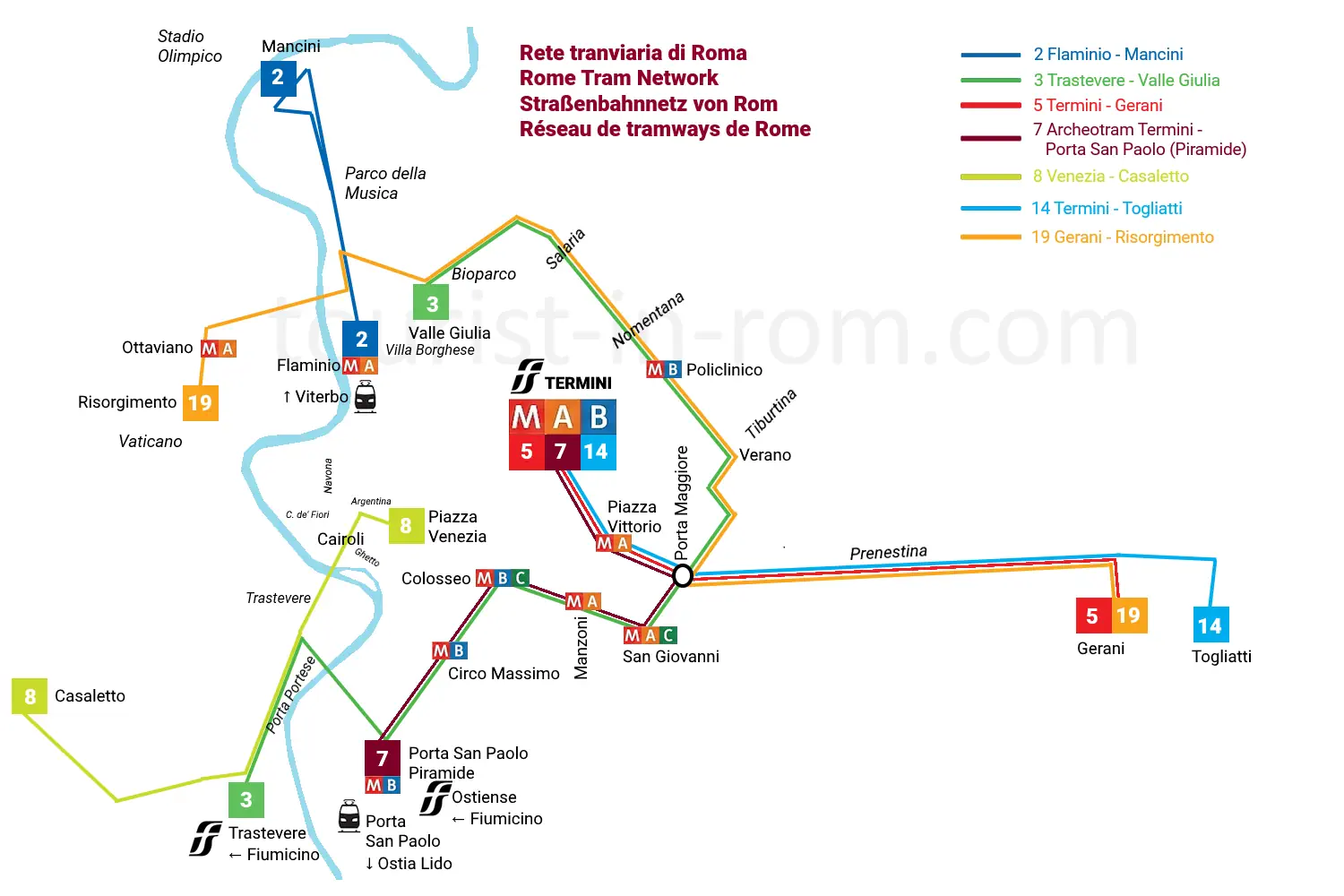
Particularly scenic is Line 3 — and if you have a free day, it makes for a wonderful self-guided tour of a less touristy Rome. Board at Trastevere station or the Pyramid and head east.
Your first stop is the Colosseum — but rather than the arena itself, explore the slope of the Celio Hill above the station, home to the Museum of the Forma Urbis and some of Rome’s most significant early Christian churches. The Caelian and Oppian Hills
Continue to San Giovanni for the Basilica and the Scala Santa — the sacred staircase said to have been climbed by Christ. One stop further brings you to Santa Croce in Gerusalemme, one of Rome’s seven pilgrimage churches.
Then comes San Lorenzo — the ancient basilica and, behind it, the vast Verano, a true città dei morti — a city of the dead — continuing the tradition of Rome’s ancient burial cities. Distinguished figures from Italian history, art and science are buried here alongside ordinary Romans. It rivals Père-Lachaise in Paris and London’s Highgate Cemetery in atmosphere and historical significance, yet most tourists never visit. Allow at least an hour — ideally more.
The tram continues through the elegant Parioli neighbourhood to the terminal at Valle Giulia, where you’ll find the Galleria Nazionale d’Arte Moderna, the Bioparco zoo, and an entrance to the Villa Borghese gardens.
Line 2 connects Piazzale Flaminio with the Parco della Musica and the Stadio Olimpico. Line 8 runs from Piazza Venezia to Trastevere. Lines 5 and 14 are commuter lines serving the eastern districts.
Archeotram – Line 7: Line 7 (Archeotram) runs with restored red trams and connects Termini with Porta Maggiore, San Giovanni, the Colosseum, the Circus Maximus and the Pyramid. The line runs infrequently – even in regular operation at most once per hour. Please check the current timetable via Moovit or Google Maps. The standard BIT ticket is valid on this line.
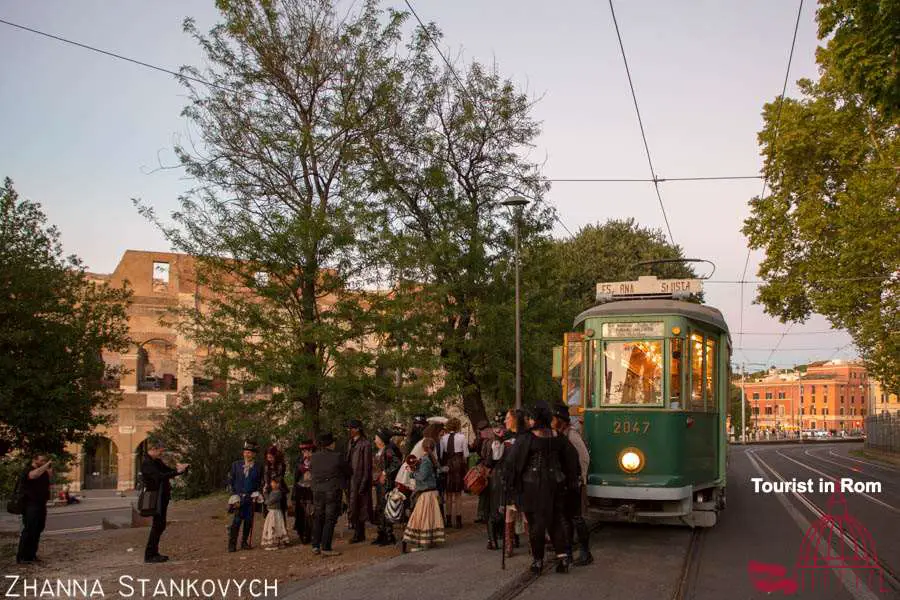
A historic 1928 tram with 30 seats is available for private hire on scenic routes through the city.
Local Trains
Rome has two local train lines within the city fare zone:
Ostia Lido line: From the Pyramid (also boarding at San Paolo Basilica) this train runs to the sea in around 30 minutes. It serves both Ostia Lido — Rome’s beach — and Ostia Antica, the remarkably preserved ancient harbour city often called Rome’s little Pompeii. Exit options along the coast: Stella Polare, Castel Fusano and Cristoforo Colombo.
Piazzale Flaminio – Viterbo line: This line serves commuters from Rome’s northern districts. The city fare zone is valid as far as Montebello station.
Regional Trains
Regional trains are operated by Trenitalia and can be used within the city with a standard Metrebus ticket. From Ostiense station the train is the fastest connection to San Pietro. The nearest station to the Vatican Museums is Valle Aurelia.
Regional trains also offer pleasant day trips to the sea, north to Civitavecchia, south to Anzio and Formia, and into the hills to Tivoli and Castel Gandolfo.
Note: Tap & Go is not valid on regional trains. For contactless payment on Trenitalia trains use the Tap & Tap system.
Timetables
For connections and departure times we recommend Moovit and Google Maps. Both apps integrate ATAC timetable data with real-time information and deliver reliable results.
Fare Evasion: Fines You Cannot Ignore
Ticket inspections are common in Rome. Anyone found without a valid ticket faces a fine of around €55 if paid within 5 days – after that the penalty can rise to up to €500. There is also a significant loss of time, as the official report must be completed on the spot.
Particularly important for groups and tour guides: every passenger must carry their own ticket. It is not sufficient for one person to hold all the tickets for the group. A common scenario: someone misses the bus and the tour leader has all the tickets – anyone then caught without a ticket must pay the fine.
Pickpockets on Public Transport
The risk of pickpocketing is particularly high on public transport – especially in the central metro stations and trains on Lines A and B, and on the busy bus routes between Roma Termini and the Vatican (lines 40, 62, 64). Keep valuables close to your body and bags securely closed at all times. More tips: pickpockets in Rome
FAQ: Public Transport in Rome
How much does a single ticket for the bus and metro cost in Rome?
A BIT single ticket costs €1.50. It is valid for 100 minutes on all transport within the city, with one entry to the metro.
How long is a Metrebus ticket valid?
The BIT single ticket is valid for 100 minutes from validation. There are also day passes (24h, 48h, 72h) and a weekly pass (CIS, 7 days).
Can you pay contactlessly on Rome’s buses and metro?
Yes. Tap & Go works on the metro, buses, trams and the Ostia line. Always using the same card means you automatically get the best fare and will never pay more than the daily cap (€8.50) within 24 hours.
Can I use contactless payment on the train to Fiumicino Airport?
Yes — but not with the Metrebus Tap & Go system. Trenitalia operates its own contactless payment system called Tap & Tap on regional trains and the Leonardo Express. Simply tap your credit or debit card when boarding and again when you exit at your destination. The fare is calculated automatically. No ticket purchase needed.
Which metro line goes to the Vatican?
Line A (orange) stops at Ottaviano, a short walk from St Peter’s Square and the Vatican Museums.
Which metro line goes to the Colosseum?
The Colosseum is served by Line B (blue) and Line C (green) – both stop at Colosseo station, where you can also change between the two lines.
Do children need a ticket?
Children under 10 travel free on the entire Metrebus network.
Where can you buy Metrebus tickets in Rome?
At machines in metro stations, at tobacconists (Tabacchi) and at newspaper kiosks. Contactless payment on board (Tap & Go) is the most convenient option for tourists.
Until what time does the Rome metro run?
The metro runs daily until approximately 23:30. On Friday and Saturday nights until approximately 1:30.
What happens if you are caught without a ticket in Rome?
The fine is around €55 if paid within 5 days, rising to up to €500 after that. Every passenger must carry their own ticket – it is not sufficient for one person in the group to hold all the tickets.
Are there night buses in Rome?
Yes. Rome has a network of night bus services. Current routes and departure times can be found via Moovit or Google Maps.

When in Rome, take a taxi!!!
Hi!
How many zones CIRS ticket need i bye for Rome – Castel Gandolfo
and for Rome – Litoranea/Varco 4 (BUS stop:70087 in OSTIA)
Best wishes: Kornel
Hi Kornel,
the 3 zone ticket is good from Rome to Castel Gandolfo. For the litoranea probably you need only a city ticket, but the 3 zones CIRS is fine for sure.
Best, Bernhard
Grazie mille, Bernhard!
Hi .from ciampo to termini station what zone do I need for main area of city I.e the Vatican can it be used from the airport
The city lines 520 from Ciampino airport to Metro A and 720 to Metro B are included in the metropolitan area (defined as 2 zones). From Ciampino city to Rome are 3 zones.
HELLO. I’M GOING TO ROME CIAMPINO OCTOBER 5. I HAVE A QUESTION.
CAN I PURCHASE A CIS TICKET (CIS) FOR 7 DAYS AT CIAMPINO AIRPORT, IF THAT WHERE IS THERE IN WHICH CIAMPINO PLACE?
IF NOT WHERE NEAR THE AIRPORT?
DO I HAVE TO ENTER YOUR PERSONAL DATA WHEN YOU PURCHASE A TICKET?
WHAT IS THE DIFFERENCE OF A TICKET (CIS) FROM A ROMA PASS CARD?
Hi,
you’ll find ticket vending machines at CIA. You have to write your name on the ticket. Probably also the Tourist Information will sell tickets or the tobacconist in the departure hall.
The Roma Pass is valid 2 or 3 days and includes one or two museums.
More details about Ciampino airport transfer
I was going to go for the Roma 72 card, but since I am having trouble booking the Colosseum, I’ve been looking for an alternative for the transportation part. It seems that the BTR regional ticket for 1 zone, Roma is a better deal than the ATAC 72 hour ticket. Do they both cover the same modes of transportation within Roma? Can they be purchased at the airport on arrival?
The metropolitan area of Rome counts as 2 zones, the cost for 3 days is 16,50 € and it expires at midnight of the 3rd day. The ATAC ticket for 18 € is a 24h ticket. If you are arriving at Fiumicino and leave within midnight of the 3rd day, I suggest to take the BTR 3 zone ticket for 22 €, this includes also the train line FL1 from the airport to the city (stations Trastevere, Ostiense, Tuscolana, Tiburtina and so on) but not the Leonardo Express. You can buy the ticket at the tobacco shop on the left side of the railways ticket counter.
I live in California, USA. My departure is on November 8, 2019 going to Rome. Can I order today date August 8, 2019 a tickets for 24 hours coming from Germany. When will be delivered in California? As mentioned on your notes, will be delivered one week before my departure it’s a long wait? Please advice what is the good time to order according to my departure? Thank you.
Hi Renato,
you can order today for November. I don’t know how long the postal service needs to California.
hi there
it’s unclear to me if the CIS card for 7 days, will take me from ciampino ariport to cinecitta metrostation. and using the samen CIS card to take me to termini or beyond
all other websites warn me that this will NOT work for airports
please let me know
Hi John,
these websites have old information. From Ciampino you can use the CIS with the city lines 520 to Cinecittà and 720 to Laurentina. The two lines 520 and 720 are rather new and run from the city bus ATAC.