
Last updated:
On the night of 18–19 July 64 AD, a fire broke out in the market stalls of the Circus Maximus, where highly flammable goods were stored. What began as a local blaze developed into a catastrophe that would change the city forever.

The Role of Emperor Nero
Nero cultivated popularity with the people through games and favours, while holding the Senate in contempt. For the senators, it was a scandal that the emperor would perform publicly as a singer and musician. His mother, his first wife, his adviser Seneca and numerous nobles and Christians all fell victim to conspiracy theories directed against him.
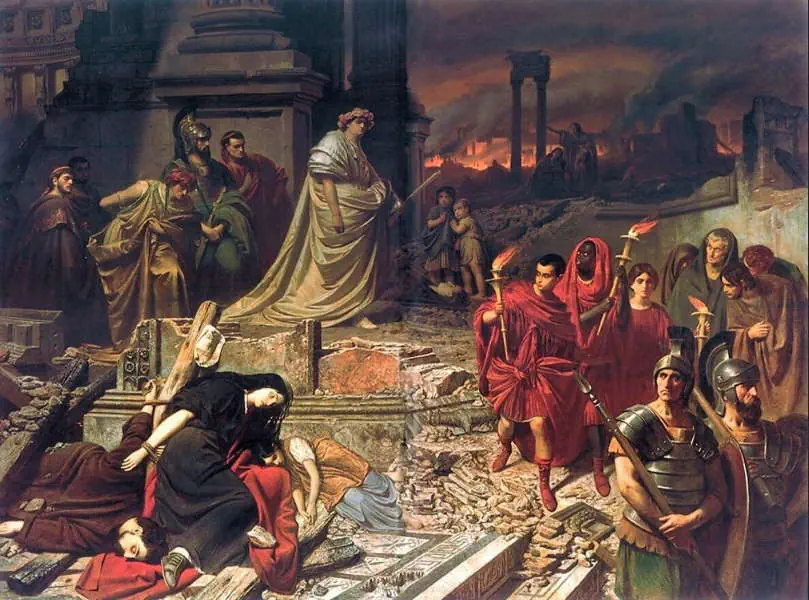
It was immediately rumoured that Nero was responsible for the fire and that he had sung of the fall of Troy while Rome burned. This may well have been malicious slander. Today we know that Nero took effective measures to fight the fire and put appropriate steps in place to help the population left homeless by the disaster. Fires were in any case a common occurrence in ancient Rome – many buildings were made of wood, and open flames were used for both cooking and lighting.
How the Fire Spread – Tacitus Reports
The historian Tacitus describes the fire in his Annals, written around fifty years after the event:
“There followed a disaster, whether accidental or treacherously contrived by the emperor, is uncertain, as authors have given both accounts, worse, however, and more dreadful than any which have ever happened to this city by the violence of fire. It had its beginning in that part of the circus which adjoins the Palatine and Caelian hills, where, amid the shops containing inflammable wares, the conflagration both broke out and instantly became so fierce and so rapid from the wind that it seized in its grasp the entire length of the circus. There were no mansions fenced by enclosing walls, or temples surrounded by walls, or any other obstacle to interpose delay. The conflagration first swept violently over the level spaces, then rising to the hills, while it again devastated every place below them, it outstripped all preventive measures; so rapid was the mischief and so completely at its mercy the city, with those narrow winding passages and irregular streets, which characterised old Rome. Nero at this time was at Antium, and did not return to Rome until the fire approached his house, which he had built to connect the Palatine with the gardens of Maecenas. It could not, however, be stopped from devouring the Palatine and the house and everything around them.”
The Scale of the Fire
Of the city’s 14 districts, three were completely destroyed: the Oppian Hill, the Palatine and the Circus Maximus. In seven further districts only a few charred remains were left standing, while four districts escaped unscathed. Thousands lost their lives and around 200,000 people were left homeless.
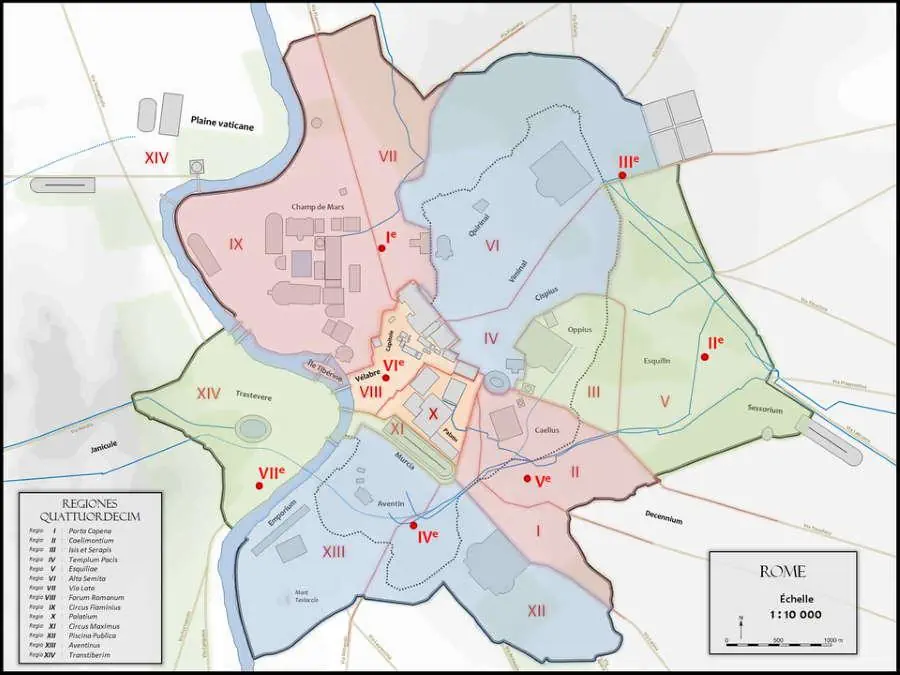
On the Palatine, Nero’s palace, the Domus Transitoria, was also destroyed. Its name derived from the fact that it connected the palace on the Palatine with the Gardens of Maecenas on the Oppian Hill. A surviving remnant of those gardens is the Temple of Maecenas on the Via Merulana.
The Cause and the Persecution of Christians
Whether the fire was an accident or the result of arson can no longer be established. In any case, Nero deflected all blame from himself and accused the Christians of having started the fire. Christians were widely despised at the time. One account suggests that a group of fanatics sought to bring about an Egyptian apocalyptic prophecy. If it was arson, however, members of the Roman Senate could equally have been responsible.
It is possible that the Christians were condemned to death under Roman law as punishment for the many lives lost in the fire. Whether any persecution of Christians actually followed the fire – or whether later writers added this to the account attributed to Tacitus – is also uncertain.
In the period following the fire, the apostles Peter and Paul were also martyred. Peter is said to have been crucified in the Circus of Nero on the Vatican Hill, while Paul was beheaded outside the city walls. The site of his execution, on the Via Laurentina, is today occupied by the Cistercian abbey of Tre Fontane. According to legend, Paul’s head struck the ground three times, and a spring arose at each spot.
The Rebuilding – the Domus Aurea
Tacitus describes the rebuilding of Nero’s palace:
“Nero meanwhile availed himself of his country’s desolation, and erected a mansion in which the jewels and gold, long familiar objects, quite vulgarised by our extravagance, were not so marvellous as the fields and lakes, with woods on one side to resemble a wilderness, and, on the other, open spaces and extensive views. The directors and contrivers of the work were Severus and Celer, who had the genius and the audacity to attempt by art even what nature had refused, and to fool away an emperor’s resources.”
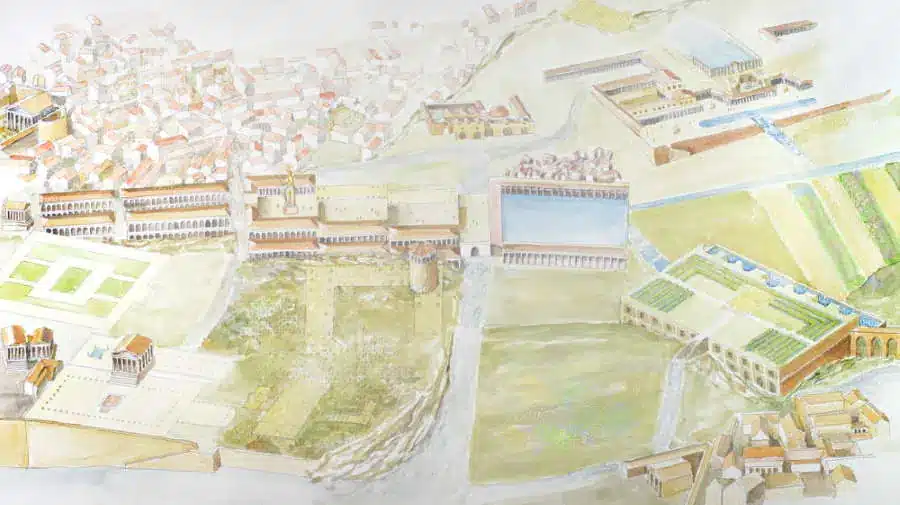
Nero thus had a vast villa built in the heart of the city – regarded by Romans as extraordinary extravagance, since such estates were normally built in the countryside. When Nero died by suicide in 68 AD, the palace was still unfinished. The decision was taken to fill in the structures on the Oppian Hill and build baths over them. In the valley between the Palatine and the Oppian Hill, where an artificial lake had been created, the Amphitheatrum Flavium was built – today’s Colosseum. Its name most likely derives from a colossal statue of Nero that stood at the entrance to his Domus Aurea.
The Domus Aurea was rediscovered by chance in the 15th century. Today, part of the complex can be visited at weekends, while excavation and conservation work continues during the week.
In the Footsteps of the Fire – Still Visible Today
Those who want to experience the history of the Great Fire first-hand will find striking traces of it across Rome today.
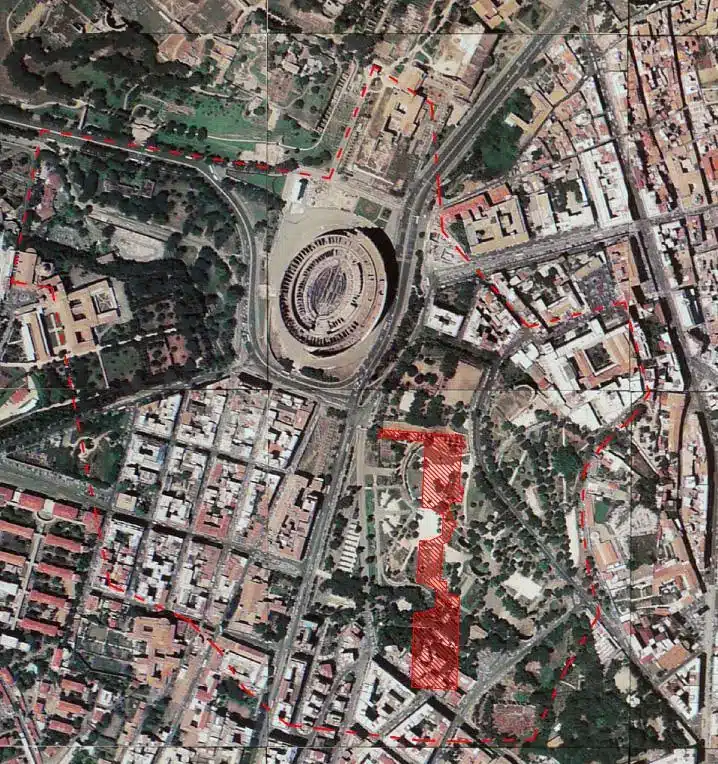
The Circus Maximus, where the fire broke out, survives as a vast open green space between the Palatine and Aventine Hills and is freely accessible. The Palatine Hill, one of the most severely affected districts, is today home to one of Rome’s most important archaeological parks and is accessible with a Colosseum ticket. The Domus Aurea – Nero’s lavish successor palace – can be visited at weekends. The Abbey of Tre Fontane on the Via Laurentina, where the Apostle Paul met his martyrdom, remains a quiet place of pilgrimage on the outskirts of the city. And the Colosseum itself stands where Nero’s artificial lake once lay – a direct legacy of the fire and the rebuilding that followed.