Last updated:
Civitavecchia is Rome’s main cruise port and the largest cruise port in the Mediterranean. The fastest way to reach Rome is by regional train or by organised shore excursion. With around six hours ashore, you can visit one or two major sights in Rome — but pre-booked tickets are essential. Alternatively, the beaches and Etruscan towns north and south of the port make for a relaxed day closer to the ship.

Civitavecchia
Civitavecchia is a working port city. Beyond the harbour, the Forte Michelangelo and the historic centre, there is not a great deal to detain you — most visitors head straight for Rome. You are in ancient Etruscan territory; traces of this civilisation can be found in the towns of Tarquinia and Cerveteri, both within easy reach of the port.
Not far away is Lake Bracciano with the Castello Odescalchi and the Italian Aviation Museum. To the south of Rome lies the volcanic Lago di Albano, above which the Popes’ summer residence rises at Castel Gandolfo. Further east, in Umbria, is Assisi with the Basilica of St. Francis.
If you already know Rome well, or simply prefer a quieter day, the surrounding countryside and beaches are well worth considering.
Ferries from Civitavecchia
Civitavecchia is also a major ferry hub. Regular services run to Sardinia, Sicily, Barcelona and Tunis.
Search ferry connections at Omio

The cruise terminal
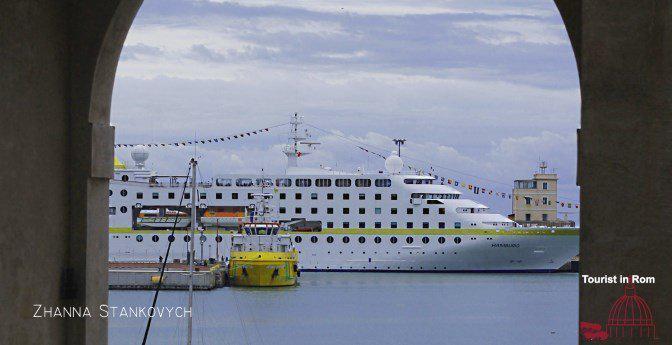
Cruise ships at Civitavecchia dock at Piers 10–13, located behind Forte Michelangelo, and at Pier 25, which is situated north of Largo della Pace. The main cruise terminals at Piers 10–13 include the Amerigo Vespucci Terminal, opened in 2018, which at 12,500 square metres is one of the largest cruise terminals in Europe, and the brand-new Donato Bramante Terminal, which opened in December 2025. Ships typically arrive in the morning and depart in the evening, giving passengers around six hours ashore.
A free port shuttle connects the ships with Largo della Pace at the port exit. From there, buses, the direct shuttle bus to Rome and taxis are available.
From the Port to Civitavecchia Train Station
From the cruise terminals at Piers 10–13, there are two options to reach Stazione di Civitavecchia:
- On foot: The station is approximately 2.2 km / 1.4 miles from the terminals — around 30 minutes’ walk along the waterfront.
- By shuttle + bus: Take the free port shuttle to Largo della Pace, then the local bus to the station for around €6, payable on board.
Taxis are also available at Largo della Pace for a faster connection.
Day Trips to Rome
Shore Excursions
Time in Rome is short, and the logistics of getting there and back independently can be stressful. A guided shore excursion takes care of transport, timing and entry tickets in one booking — and guarantees you are back at the ship on time.
Book shore excursions from Civitavecchia on GetYourGuide
Shuttle Bus to Rome
A direct shuttle bus connects the Civitavecchia cruise port with Rome. The journey takes around 60–70 minutes depending on traffic. The price is approximately €15 per person one way. Shuttle buses depart from Largo della Pace.
Train from Civitavecchia to Rome
The train is the most flexible and affordable option for independent travellers. Tickets can be purchased at machines in Civitavecchia station or in advance via Trenitalia on Omio. Always validate your ticket before boarding if you have a paper ticket.
There are two types of train connection:
The regional train (Trenitalia regionale) costs around €5 and takes approximately 60 minutes to Roma San Pietro, 70 minutes to Roma Ostiense and 80 minutes to Roma Termini. Trains run frequently throughout the day.
The Intercity train costs around €12 and is considerably faster: roughly 45 minutes to Roma Termini and 40 minutes to Roma Ostiense. Note that Intercity trains do not stop at Roma San Pietro.
For more information on arriving in Rome by train, see our Rome by train guide.
Which station to alight at in Rome:
- Roma San Pietro (regional trains only) — the closest station to St. Peter’s Basilica and the Vatican. From here it is a short walk to St. Peter’s Square.
- Roma Ostiense — for the Colosseum. Take Metro Line B two stops to Colosseo.
- Roma Termini — Rome’s main hub, with metro and bus connections to all parts of the city.
What to See in Rome in 6 Hours
Six hours in Rome is enough time to visit one major site properly. Pre-booking is essential for the Colosseum; walk-up tickets are rarely available. For St. Peter’s Basilica, expect to queue up to an hour without a reserved slot.
A realistic itinerary on foot from Roma San Pietro: St. Peter’s Square → Castel Sant’Angelo → Piazza Navona → Pantheon → Trevi Fountain. That covers around 8 km / 5 miles. Adding the Spanish Steps means roughly another 2 km / 1.25 miles.
From Roma Ostiense, head to the Colosseum and Roman Forum first, then — if time permits — continue towards the Pantheon or Trevi Fountain.
Colosseum tickets and guided tours Vatican Museums – best tickets St. Peter’s Basilica – tickets and opening hours
Other Day Trips
The area around Civitavecchia offers several worthwhile destinations, particularly for those who have already visited Rome.
In Tarquinia, an Etruscan necropolis and archaeological museum can be visited. Cerveteri is home to the UNESCO-listed Necropolis of the Banditaccia, one of the best-preserved Etruscan burial sites in the world.
The city of Viterbo in northern Lazio was the site of the longest papal election in history, lasting from 1268 to 1271. The cardinals were eventually locked in the papal palace, put on a diet of bread and water, and the roof was opened to the elements — forcing a decision. It was the first conclave in history to elect a Pope in this way.
For a day at the beach, take the regional train to Santa Severa or Ladispoli. At Santa Severa there is a castle from the 14th century and an excellent fish restaurant, the Isola del Pescatore — reservations are recommended. At Ladispoli there are various bathing establishments with restaurants. Just outside Ladispoli, the medieval defence tower Torre Flavia stands at the edge of a protected coastal marshland.
Getting to Civitavecchia
The port of Civitavecchia is 76 km / 47 miles northwest of central Rome. Rome Fiumicino Airport is 70 km / 44 miles away; Rome Ciampino Airport is 90 km / 56 miles away.
Taxi
A fixed fare of €130 applies from Fiumicino Airport to Civitavecchia. From the centre of Rome (within the Aurelian Walls) the fixed fare is €150. All other journeys are metered.
From Fiumicino Airport there is also a direct regional train to Civitavecchia: take the train towards Rome and change at Trastevere. From Genoa, a scenic coastal route runs via Pisa to Civitavecchia and onwards to Rome.
By Car
From Rome, take the Via Aurelia (SS1) or the Roma–Fiumicino motorway and follow signs for Civitavecchia. Coming from the north, the coastal road from Pisa is scenic but slower. Another attractive route leads from Florence via Siena and Grosseto. Speed controls are frequent on both routes.
The closest car park to the cruise terminals is Parcheggio Bramante.
History of Civitavecchia
The port was built in 106 AD at the request of Emperor Trajan — he was also the city’s founder, who named it Centumcellae. Its purpose was to secure Rome’s food supply through a second, safer harbour.
The port was designed by the architect Apollodoros of Damascus. It consisted of an almost circular basin, roughly a third of a Roman mile across, with two piers, a breakwater, an artificial island and four entrance towers.
Remains of one tower are still visible on the pier known as “il bicchiere”. Opposite stands the tower “del Lazzaretto”, built on the site of an ancient predecessor. The ancient harbour basin is still supplied with fresh water via an underground tunnel system that has functioned continuously since antiquity.
After the fall of the Roman Empire the port declined, until it came under papal control in the 15th century. The Forte Michelangelo, which still stands today, was completed in 1537. A lighthouse was added in 1608 and destroyed in the Second World War. Other papal additions include the Porta Livorno (1679) and the Fontana Vanvitelli (1743).
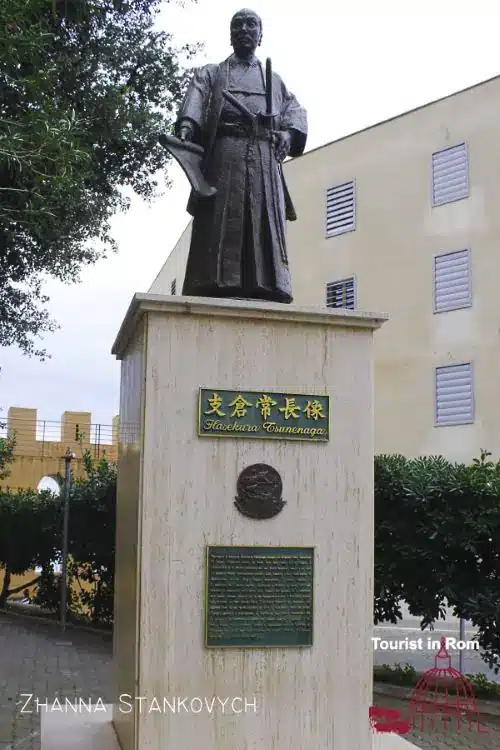
Above the Porta Livorno stands the statue of the Japanese samurai and diplomat Hasekura Tsunenaga. In November 1615, he delivered a letter to Pope Paul V proposing a trade agreement between Japan and Mexico and inviting missionaries to Japan. His journey from Japan via Mexico and across Europe and back took almost seven years, from October 1613 to August 1620.
At the end of the First World War, the port served as a base for airboat postal services to Sardinia.
Frequently Asked Questions
How far is Civitavecchia from Rome?
The port of Civitavecchia is 76 km / 47 miles from the centre of Rome, roughly one hour by train or 60–90 minutes by road depending on traffic.
How do I get from Civitavecchia to Rome?
The main options are the regional train (approx. €5, 60–80 min), the Intercity train (approx. €12, 40–45 min to Termini), a direct shuttle bus (approx. €15, 60–70 min) or a guided shore excursion with transport included. Taxis exist but are expensive for the full distance.
How long does the train take from Civitavecchia to Rome?
Regional trains take around 60 minutes to Roma San Pietro, 70 minutes to Roma Ostiense and 80 minutes to Roma Termini. The Intercity takes approximately 40 minutes to Ostiense and 45 minutes to Termini, but does not stop at San Pietro.
How much does the train from Civitavecchia to Rome cost?
A regional train ticket costs approximately €5. An Intercity ticket costs approximately €12.
Is there a shuttle bus from the Civitavecchia cruise port to Rome?
Yes. A direct shuttle bus departs from Largo della Pace at the port exit for approximately €15 per person one way.
How do I get from the ship to Civitavecchia train station?
From the cruise terminals at Piers 10–13, you can walk to the station in approximately 30 minutes (2.2 km / 1.4 miles) along the waterfront. Alternatively, take the free port shuttle to Largo della Pace and from there the local bus to the station for around €6, payable on board.
How much time do I have in Rome from a Civitavecchia cruise stop?
Ships typically arrive in the morning and depart in the evening, giving passengers around six hours ashore. That is enough time to visit one major sight — two if you are well-organised and have pre-booked all tickets in advance.
Do I need to pre-book tickets for Rome attractions?
Yes, particularly for the Colosseum, where timed-entry tickets must be booked in advance. Walk-up availability is very limited. For St. Peter’s Basilica, queues without a reserved slot can reach up to one hour.
What is the fixed taxi fare from Fiumicino Airport to Civitavecchia?
The fixed fare is €130 from Fiumicino Airport and €150 from the centre of Rome within the Aurelian Walls.
Hello
We would greatly appreciate it if you give us info as follows-
WE two Canadian seniors arrive getting off the Holland ship on Oct.,2019. Please advise us which is the best /reasonable way to get to Trevi Luxry Rooms?
Please e mail your ideas on this which will be very helpful
Hello,
As your destination at the Trevi Fountain is difficult to reach by public transport from the port of Civitavecchia, I would recommend a private transport. With this Civitavecchia transfer you pay less than by taxi and it offers a door to door service.
Please also read our page about Civitavecchia Transfer.